Showing posts with label grammar. Show all posts

Thursday, July 26, 2012

Grammar Rules: Subject and Verb Agreement

Mini-Lesson on the grammar rules surrounding subject-verb agreement.

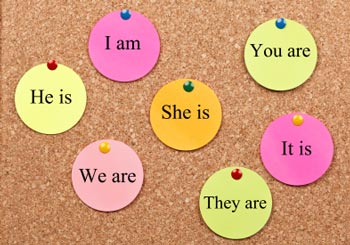
grammar rules subject verb agreementThe rule is simple: singular subjects take singular verbs and plural subjects take plural verbs. But sometimes it’s difficult to tell whether a subject is singular or plural. That’s why subject and verb agreement errors crop up in so many pieces of writing. Making matters worse is the fact that most people don’t know what subject and verb agreement means. In fact, too many people don’t know a subject from a verb.

When you’re fixing up your sentences and making sure they are correct, it helps to know the parts of speech, how to conjugate a verb, and how to diagram a sentence (so you can identify the subject). If you understand all those basic elements of language, then you can easily make sure your subjects and verbs agree.

Monday, March 05, 2012

Grammaropolis: Personified Parts of Speech

Grammaropolis: Personified Parts of Speech


What it is: Grammaropolis is a site I have long been a fan of. I’ve written about it in the past in these posts. Grammaropolis recently got a significant upgrade with TONS of new, great features. The site now includes character descriptions for nouns, verbs, adjectives, adverbs, pronouns, conjunctions, prepositions and interjections. In addition to the great descriptions, each character includes a song, videos, book, games and, soon, quizzes. Not all of this content is free, but there is enough free content to be useful in every classroom no matter the budget. All of the content associated with the Noun character is free. Every other character includes the character description and book for free. The music, videos, quizzes and games are “extras” that are available by subscription.

Sunday, August 15, 2010

how to learn a language

How to learn a foreign language is the million dollar question, but actually there is no magic answer. Many factors should be taken into consideration, as well as tools useful for learning a new language. The good news is that there are methods and techniques to use.


Language Components
Language Tools
Vocabulary
Grammar
Writing
Listening and Speaking
Memory
Practice
Motivation


Thursday, April 29, 2010

Practice Parts Of Speech


The University of Nottingham has a nifty online tool where where students can practice multiple parts of speech (adverbs, articles, etc.) with any piece of 300 word text they, or their teacher, choose. And it can be used with several languages, including English.


It's just a matter of pasting the text in, clicking a button, and you're presented with the exercise.

Sunday, March 21, 2010

Grammar Websites to Fix Students' Most Common Grammar Errors in Writing

Don't take this as a directive to obsess about grammar ~ or fuss over it when you should be writing drafts and concerned with content and organization. If you can identify, recognize and fix your own most common errors, that will take care of 95% of writing mistakes. Don't sweat the other 5% unless they interfere with meaning. You will also find that your error patterns are not as unique as you may think ~ most will fall into "most common" categories.


Students will find English grammar help for their most common written grammar errors in selected grammar websites. The list is organized according to grammar and punctuation errors commonly found in students' and adults' writing.

Friday, January 29, 2010

11 Rules of Writing -- a concise guide to important grammar, punctuation, and writing style rules

Oops... I have been emailing study materials but did not realize until just now that my messages were going into drafts instead of being published immediately.

A handy writing resource for your personal resource file, Bookmark: http://www.junketstudies.com/rulesofw/

My notes: This site is a concise guide to some of the most commonly violated rules of writing, grammar, and punctuation. It is intended for all writers as an aid in the learning and refining of writing skills. Explore each of the rules to see examples of its application, and use the references to find additional explanations and examples on the Web or in print. Look up grammatical terms in the glossary.

For a wider variety of information, check related FAQs and other writing resources. Also, click on the Word of the Day until you've learned a few new words.

Reblog this post [with Zemanta]

Wednesday, February 11, 2009

Verb Tenses

The other day I read this sentence:
The number of cars was risen 10% over the last five years….

You are right if you think this looks wrong - it is wrong! But it is not unusual to see sentences like this. The general structure of the sentence is sound (word order, use of articles etc) but the writer doesn’t know how to build up compound verbs properly.

(The correct version is: The number of cars has risen / has been rising over the last five years..)

I know that verb tenses get difficult with auxiliary verbs and when a sentence is in the passive voice - a new bridge has been built in the city center. Even more things can go wrong with compound verbs. Don’t just guess! There are only a few possibilities that you can use. Take another look at the sentence:
The number of cars was risen 10% over the last five years….

Once you decide that the subject of the sentence is singular (the number) and the verb is active then the grammatical possibilities for the verb are:

1. The number of cars rises over the last five years….

2. The number of cars is rising over the last five years….

3. The number of cars has risen over the last five years….

4. The number of cars has been rising over the last five years….

5. The number of cars rose over the last five years….

6. The number of cars was rising over the last five years….

7. The number of cars had risen over the last five years….

8. The number of cars had been rising over the last five years….

Any of these sentences, even the wrong ones, reads far better than the original sentence that I gave you. Some that are not correct are acceptable and would not upset the reader too much. If you are not sure of the possible verb forms take a look at a verb chart like the one here on Englishpage.com.

Follow the link scroll down the page to the VERB TENSE OVERVIEW table near the bottom of the page. You can see all the tenses laid out. Use what you think is the most appropriate one and make sure you make your verb agree with the subject of the sentence. Even if you choose the wrong tense your writing will be far more acceptable than if you put something grammatically impossible!
Thursday, August 28, 2008

Word Games

These online word games look like fun (not all learning has to be serious). And of, don't forget Grammar Gorillas...

I've always enjoyed Wacky Web Tales - good practice for writing and grammar. Who can come up with and post the wackiest tale? MadLibs are more grown up - just as hilarious. Try mad-libbing your own version of "Eleanor Rigby" by the Beatles or The Princess and the Pea

Grammar games - and more English language games & BBC skillwise games

Three games to test your longer sentence skills
. Spot the sentences, make sentences and put a text into sentences.

Have fun - and please share your wackiest web tale/madlibs.

Tuesday, June 17, 2008

Play It 4 Word

A Game of Wits and Words for ESL learners, Basic Writers, High School English, Developmental Writing and First Year Composition. http://www.stevenleeclimer.com/PI4/

The object is to be the first to complete a sentence and get all the points. Playing the game that teaches learners of all levels the parts of speech and word position and helps students understand parts of speech and how English sentences are constructed

Play it 4word rules
http://www.stevenleeclimer.com/PI4/pi4_rules_traditional.html

Also in Junior (for beginning readers, ESL beginners, literacy programs), Wicked (not for the squeamish or vocabulary challenged), MLA and APA versions. PlayIt4Word MLA and APA are described as a fun way to learn documentation of research in an essay. The ultimate oxymoron, or what?

Saturday, April 05, 2008

Sunday, November 25, 2007

Grammar Police: Keeping the Web and the World Safe from Bad English

This grammar site is both entertaining and educational, which is not something we can say about all grammar web sites.

Grammar Police is dedicated to saving the web and the world from bad grammar, poor diction, and the abuse of the English language in general. If you have a suggestion for an article, a pet peeve you want to get off your chest, or any other feedback, please contact the Grammar Police.


Recent Posts


Categories

For fast-acting relief try slowing down (Lily Tomlin)


Thursday, November 01, 2007

English grammar website

Hi everyone,

I'd like to share this website
http://www.fortunecity.com/bally/durrus/153/gramtoc.html
that I just found it and I think there are so many good examples and explantions. hope you like it =]

Happy Halloween
Tai

Sunday, December 10, 2006

Parts of Speech

Three little words you often see
Are ARTICLES: a, an, and the.

A NOUN's the name of anything,
As: school or garden, toy, or swing.

ADJECTIVES tell the kind of noun,
As: great, small, pretty, white, or brown.

VERBS tell of something being done:
To read, write, count, sing, jump, or run.

How things are done the ADVERBS tell,
As: slowly, quickly, badly, well.

CONJUNCTIONS join the words together,
As: men and women, wind or weather.

The PREPOSITION stands before
A noun as: in or through a door.

The INTERJECTION shows surprise
As: Oh, how pretty! Ah! how wise!

The whole are called the PARTS of SPEECH,
Which reading, writing, speaking teach.

The follwing list is by no means comprehensive. Consider it a start - to be developed as we go along. Do you have your own favorite pages about parts of speech? Please share them with us.


Reviews, handouts, study resources

Quizzes (many including reviews)

Games

What is the difference between parts of speech and parts of the sentence?
Related Posts Plugin for WordPress, Blogger...